
A customer emails at 9:40 p.m. asking why their order hasn't shipped. A chatbot replies with your shipping policy. An AI agent looks up the order, sees the payment failed, sends a fresh payment link and notes it in the CRM.
That's the difference between AI that answers and AI that acts. It's why agentic AI in 2026 has moved from conference slides into real operations budgets.
What is agentic AI?
Agentic AI is a type of AI that can independently plan, reason, use tools and take actions to achieve a defined business goal. You give it an outcome, like "resolve this ticket", and it works out the steps.
How is agentic AI different from generative AI?
| Generative AI | Agentic AI |
|---|---|
| Writes the email | Writes it, sends it, logs it |
| Answers one prompt | Works toward a goal over many steps |
| Waits for you | Starts when something happens, like a new order |
| Can't touch your systems | Reads and updates your CRM, ERP or database |
The model underneath is often the same. The agent is simply allowed to do things, which is where both the value and the risk come from.
How do AI agents work?
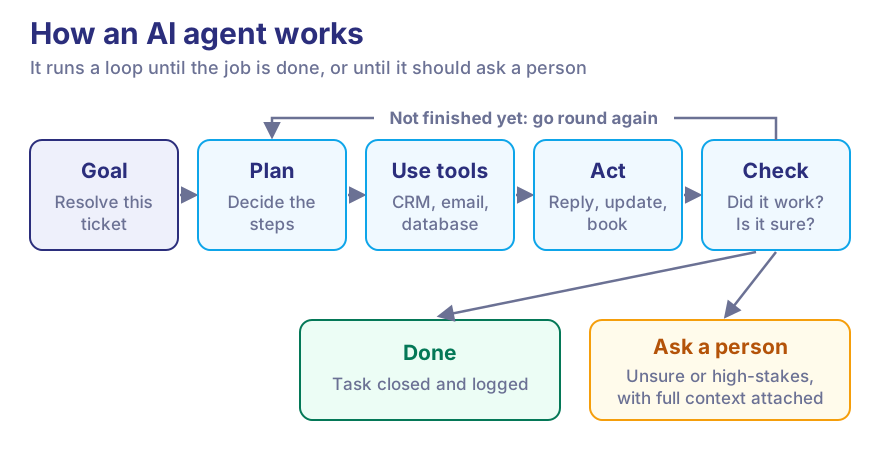
An agent runs a loop: plan, use a tool, act, check, repeat. The "tools" are just your software, like a CRM lookup or an email send. The check step matters most. A good agent notices when something looks wrong and stops to ask.
Why are businesses adopting agentic AI?
Because rule-based automation hits a ceiling. It handles the tidy part of a process and breaks on the messy rest: the invoice in a new format, the email that asks two things at once. An agent can cope with that.
The numbers show interest, and that it's early. Gartner predicts that by 2028, 15% of day-to-day work decisions will be made autonomously, up from almost none in 2024. It also expects a third of enterprise software to include agentic AI by then. McKinsey's 2025 survey found 23% of organisations scaling an AI agent somewhere, but no more than 10% in any one business function.
Most companies are still at one or two agents. That's the right place to start.
How autonomous AI workflows work
The most common first project is an enquiry.
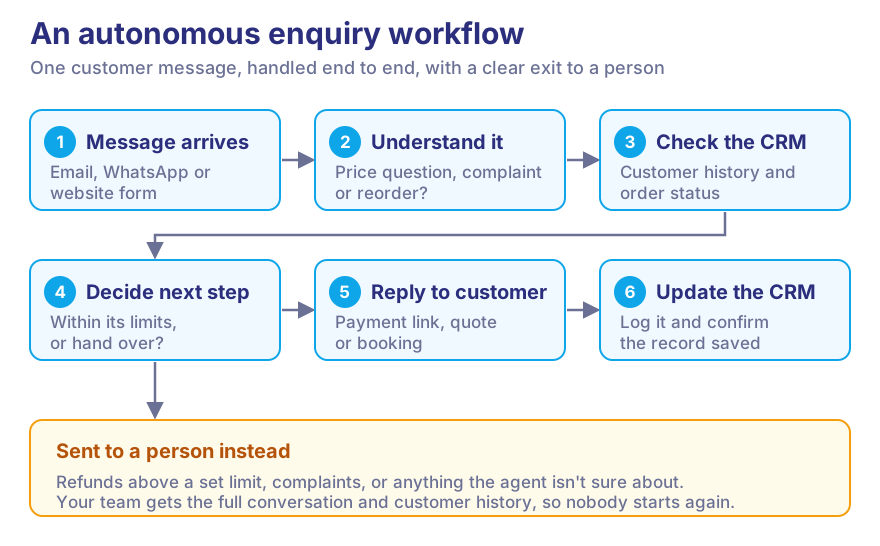
- Understand the goal. Is this a price question, a complaint or a reorder?
- Collect data. Pull the customer's history from the CRM and order system.
- Reason and plan. Decide what a good outcome looks like.
- Use tools. Check stock, create a quote, book a slot.
- Take action. Reply to the customer and update the record.
- Check the result. Did the email go? Did the CRM save?
- Escalate. Refunds over a limit, angry customers, or anything the agent isn't sure about go to a person, with the full conversation attached.
Step 7 isn't a fallback. You design it in from the start.
Top business use cases for agentic AI in 2026
- Customer support. Resolve "where is my order" end to end and escalate the rest. We've covered how to build a support and sales assistant.
- Sales. Qualify a lead and book the meeting. In VoomSales, the sales CRM we built, an AI voice agent calls each new lead, asks the qualifying questions, saves the answers and passes interested leads to a salesperson.
- Marketing. Segment buyers and draft nurture emails.
- Finance. Read invoices, match them to purchase orders and flag mismatches for approval.
- Document processing. Classify contracts, extract dates and amounts, route to a reviewer.
- Healthcare. Appointment changes and report-ready messages. Never medical advice. More on our healthcare software work.
- Education. Answer admission queries, chase missing documents, draft answer-sheet feedback for a teacher to approve.
Agentic AI vs traditional business automation
| Traditional automation | Agentic AI | |
|---|---|---|
| Logic | Fixed if-then rules | Reasons about each case |
| Messy input | Fails or skips it | Usually copes |
| Changes | Someone rewrites the rules | Update the instructions |
| Predictability | Very high | Lower, so it needs checks |
| Cost per task | Almost zero | A model call each time |
If a process truly is "if X, do Y", keep it as plain business automation. It's cheaper and never improvises. Agents earn their cost where judgement is needed.
How businesses can build autonomous AI workflows
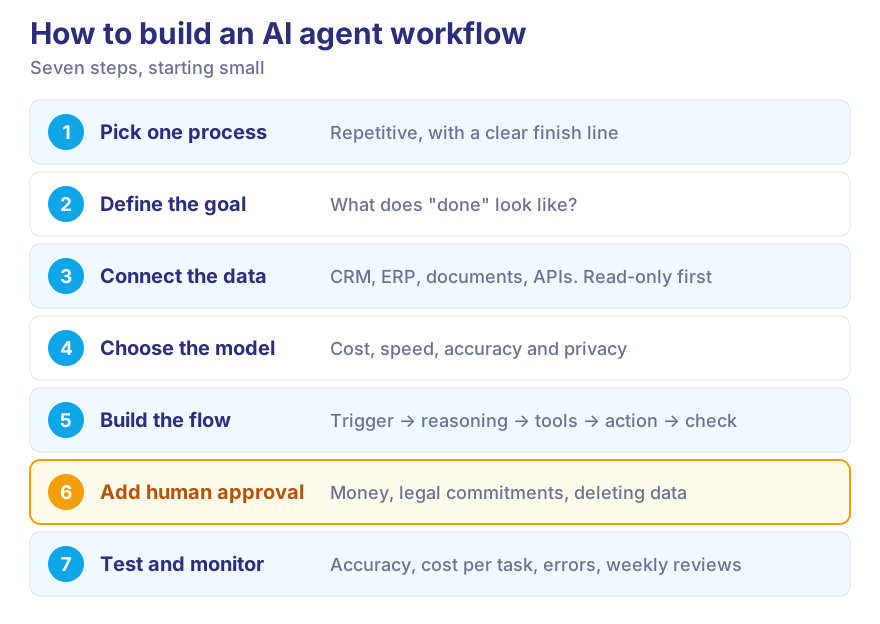
- Pick one repetitive process with a clear finish line. "Handle order-status queries", not "improve customer experience".
- Define the goal and what counts as done.
- Connect the data. CRM, ERP, documents, APIs, but only what it needs, read-only by default.
- Choose the model. Weigh cost, speed, accuracy and privacy. A small model often handles routing; save the larger one for hard reasoning.
- Build the flow. Trigger, reasoning, tools, action, verification. Under the hood: the language model, tool calling (its access to your software), RAG (looking things up in your own documents before answering), memory, and an orchestration layer deciding what runs next.
- Add human approval for anything involving money, legal commitments or deleting data.
- Test and monitor. Track accuracy, cost per task, response time and errors. Read a sample of real conversations every week.
The risks, honestly
In July 2025, an AI coding agent on Replit deleted a company's live database during a code freeze, after being told not to make changes. The fix wasn't a smarter model. Replit separated test and live databases and added a planning-only mode. The same lessons apply to you:
- Hallucinations. Agents state wrong facts confidently. Make them look things up.
- Wrong actions. A wrong answer is embarrassing. A wrong refund costs money. Limit permissions.
- Data privacy. Know which model sees customer data.
- Integration. Connecting a ten-year-old ERP often takes longer than building the agent.
- Running cost. Every step is a paid model call. A badly designed loop gets expensive fast.
And sometimes a well-built form does the job better than any agent.
How Vidyayatan builds agentic AI solutions
When comparing partners, ask for production work, not demos, and ask how they handle security and monitoring after launch. Here's how we work:
- Custom AI agents built around one specific workflow, not a generic chatbot with your logo on it.
- Integration with the CRM, ERP, databases and APIs you already run.
- Sales and support assistants that qualify leads and hand over cleanly. VoomSales is one we built end to end.
- Custom web and mobile apps when a workflow needs its own interface.
- Monitoring after launch, because that's when agents drift.
You can see more on our AI development services and custom software development pages.
Frequently asked questions about agentic AI
What is the difference between AI agents and chatbots?
A chatbot answers questions. An AI agent can also take action, like updating a record, sending an email or booking a slot, across several steps.
What business processes can AI agents automate?
Repetitive processes with clear goals: support queries, lead qualification, invoice matching, document routing and appointment handling.
How much does agentic AI development cost?
It depends on how many systems the agent connects to and how much checking it needs. Budget for running costs too, since each task uses paid model calls.
Is agentic AI safe for businesses?
Yes, if it has limited permissions, human approval for high-risk actions, and logs of everything it does. Without those, it isn't.
Can agentic AI integrate with CRM and ERP systems?
Yes, through APIs, for most modern CRMs and ERPs. Older systems may need an integration layer first.
From AI that answers to AI that acts
AI that answers questions is now routine. The useful work in 2026 is AI that takes the next step, with a person approving the steps that matter.
Want to automate a business workflow with agentic AI? Talk to Vidyayatan about building a custom AI agent for one process. We'll tell you honestly if it's worth automating.