

Most companies' first generative AI project was a chatbot. Most never made or saved any money. The two facts are related.
By mid-2025, 88% of organisations told McKinsey they use AI somewhere — yet only 39% could point to any effect on profit. MIT found about 95% of generative AI pilots produced no measurable return, and most budgets went to sales and marketing while returns came from the back office.
We build generative AI systems for clients at Vidyayatan, and the pattern repeats: launch a support bot, watch it plateau, conclude "AI" has been tried. Here is what got skipped.
Why everyone wants a chatbot right now
The demand is rational. Customers want an answer now. In Zendesk's 2025 CX Trends survey of about 5,100 consumers, 67% said they are ready to hand tasks like order tracking to AI, and 63% would switch to a competitor after a single bad experience. Gartner expects chatbots to be the primary customer-service channel for about a quarter of organisations by 2027.
For a growing business the appeal is concrete. A bot answers at 2 a.m. when the team is asleep. It handles the hundredth "where is my order?" without a hiring round. It captures a lead on the pricing page instead of losing it to a contact form nobody fills in. And it grows with order volume, not headcount — which is why Klarna's first-month numbers, covered below, looked the way they did.
All of that is real, and a well-built bot does earn its keep. The point of this post is what comes next: the same technology that answers a customer can also do a hundred jobs where no customer is involved — and that is where most of the money is.
Why the chatbot hype misses the bigger picture
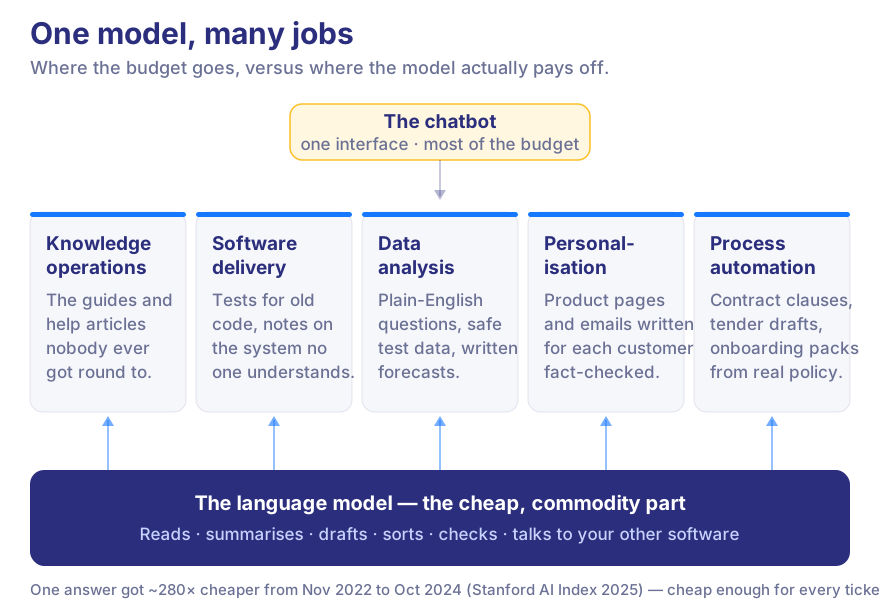
A chatbot is the demo that sells the technology, not the technology. A language model is plumbing, like a database: it reads, summarises, drafts, sorts and checks text, and talks to your other software. A chatbot is one tap on that pipe.
Stanford's AI Index found the cost of a GPT-3.5-level answer fell 280-fold from November 2022 to October 2024. At that price you run a model on every ticket, invoice and code change — where the returns actually show up. The problem with "custom AI chatbot development" is not that chatbots are bad. It is that companies stop there.
Use case 1: content and knowledge operations
Every company over fifty people has a documentation problem: the guide is stale and the real steps live in someone's head. A model can read your tickets, meeting notes and code, then draft the guide that should exist for a person to correct. Example: this month's most-asked support question becomes a draft help-centre article, written from answers agents already gave. A background job, not a chat window. The catch: it needs information you are allowed to use and can actually export.
Use case 2: software development acceleration
In METR's controlled trial, experienced developers took 19% longer with AI tools — while believing they were 20% faster. The dependable wins: tests for old code, documenting the system nobody understands, upgrade grunt work. Generative AI development services earn their fee on the checks around the model, so AI-written code does not become tomorrow's maintenance problem. The model is cheap; deciding what to build is still an engineer's job.
Use case 3: data analysis and forecasting
"Ask in plain English, get a chart" works about 70% of the time. It breaks when the answer depends on knowing status code 3 means "cancelled but refundable" — knowledge nobody wrote down. Two quieter uses hold up better. Made-up test data: when real customer records are off-limits, a model invents realistic ones — we used a thousand simulated students to stress-test an exam platform, and stayed clear of India's DPDP Act. Written explanations: turning forecast numbers into a page the board will read.
Use case 4: personalisation at scale
Writing ten thousand product descriptions is easy. Ten thousand correct ones is the job. The pattern: product data in, model drafts to a template, a check compares every claim to the real record, a person spot-checks. Retailers use it for pages nobody would write by hand; financial-services firms use it to tell each customer why their premium changed. No chat needed — the page is already written.
Use case 5: process automation and decision support
Back-office paperwork gave MIT's study its clearest returns. Contracts: pull out the term, exit clause and liability cap, each pointing to its page. Tenders: draft the 60% that repeats, so the sales engineer writes the 40% that wins. HR: onboarding packs from your actual policies; résumé screening only with a person deciding. A managers' "copilot" comes last; without those pipelines feeding it, it answers confidently from stale data.
Where custom AI chatbot development still matters
The generic chatbot is dead. The focused one is not. Klarna's assistant handled two-thirds of customer chats in its first month: 2.3 million conversations. By May 2025 it was hiring people again because quality slipped.
Vidyayatan builds custom AI chatbots around one job — reschedule this delivery, find my refund, get this student logged in. It connects to your real data, does the task, and hands over to a person with the full conversation. We built this for Habuild's WhatsApp engagement, which messages every member personally, automatically. If the brief is "a chatbot for the website", we ask what it must actually do.
How to choose the right generative AI development services partner
Three things matter: experience connecting to systems like yours (the model is a commodity; your order system is not), data handling you could explain to an auditor, and an honest view on build versus buy. MIT found bought or partnered tools succeeded about 67% of the time, in-house builds a third as often. Buy the model, build the connections, own your data; see Habuild's build-versus-buy decision and our AI strategy guide.
Four questions for any vendor: how will we know it is working, and who owns that number? What if the model provider raises prices? Show me tests from a past project. What did you tell a client not to build? Gartner expects over 40% of AI agent projects to be cancelled by 2027; these questions keep you out.
Getting started: a practical roadmap
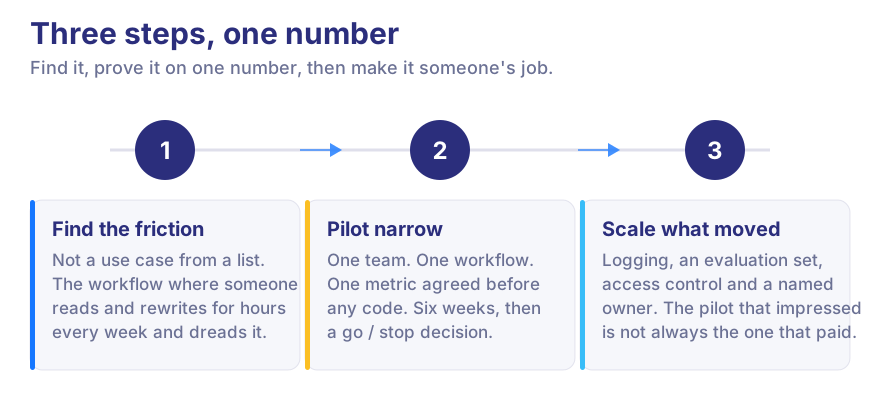
Step 1 — find the pain. Not a use case from a list; the job someone dreads every week.
Step 2 — pilot small. One team, one number agreed before any code, six weeks, then go or stop.
Step 3 — scale what worked. Monitoring, testing, a named owner. Our engagements run this way: discovery, small pilot, then making it production-ready, with the engagement model changing at each step.
Conclusion
Generative AI's value for a business is not in the conversation. It is in the thousand small acts of reading, drafting, checking and sorting that happen daily, mostly nowhere near a customer. Whether you need a purpose-built chatbot, one of the five workflows above, or help choosing, talk to Vidyayatan's generative AI development team. We will start by telling you which ones would not.